


❥♩ This chapter was born to: Flight from the city ~ Jóhann Jóhannsson. Listen while you read.
New here? Chapter 6 is where the pattern begins:

I was stirring a pot of chicken soup when I caught myself humming.
Shawty get... Shawty get... Inspired… How ‘bout that...
My brain went to my mum’s marinated fried chicken…
juicy, five-spice, hot from the wok.
The KFC jingle, scorched in, baked into my brain like the burnt gunk on a roasting pan you can’t get rid of for years.
This isn’t a side effect.
This is the product.
They didn’t choose that jingle by accident. The song isn’t selling you anything. It already moved in.
I shut the door on ads years ago. Mainstream TV, too.
But a few weeks ago I sat on the couch on a Sunday night with a pen in my hand, free-to-air television running, no popcorn.
Since I’d asked you to do the Rare Attention™ in Practice No. 1, I figured I should sit through it myself.
I usually watch SBS. Documentaries, foreign films, the kind of programming most of the country scrolls past. That night I changed the channel on purpose. I wanted to see what mainstream Australia was being fed on a Sunday night.
Channel 9 was showing Married at First Sight. Less than two hours of TV time, here’s what I noted.1
Pepsi. KFC. Subway, eat. Doordash. UberEats, again. VB beer, wash it down. Cellarbrations, drink more. AAMI insurance, in case it all goes wrong. Juniper diet program, fix it — right after the KFC and Pepsi. Moisturisers, hide the damage. Iron supplements, repair what you just broke. Pet parasite protection, keep something alive at least. Big W $29 vacuum, replace it when it breaks.
I started writing faster just to keep up.
KIA, more SUVs. Move faster. Go further. Big 4 Holiday Parks, escape. Ladbrokes bets, waste more money. A game show trailer, feel something upstairs. Chemist Warehouse vitamin C. Patch it up. Harvey Norman sale. Fill the house. KFC. Again.
Ouf... I had to switch the TV off. I was exhausted.
All of it cut at speed, in saturated primary colours, one slamming into the next. Bright. Blinding.
Look at what it’s selling. Ease. Fear. Shame. Belonging. Intoxication. Convenience. Guilt. Certainty.
Not one item requires you to perceive anything.
… and no one cooked anything.
MAFS intrigued me in an anthropological kind of way.
Strangers paired by producers, in front of cameras, on a schedule. Every condition designed to make the unspoken languages impossible. What remains is talking. And under that kind of pressure, it collapses into its worst form.
Rage. Drama. Suspicion. Contempt. Season after season.
A show designed around love. Running thirteen seasons on everything but.
Artificial love, at scale.
The show isn’t broken. It’s working exactly as designed.
They’ve built a platform for connection that produces loneliness. A food system for nourishment that produces obesity. A Sunday night meant for rest that produced two hours of manufactured anxiety.
The ads and the show share the same architecture. One is selling you KFC.
The other is selling you the emotional state that makes you need it.
Something shifted while I was writing this. I’ll come back to it.
Why does Coca-Cola still advertise?
Coca-Cola is one of the most recognised brands in human history. Over a century old, operating in 200+ countries. Almost everyone in the developed world knows Coke. And every year, it spends approximately four to five billion dollars reminding you it exists.
Just in case you forgot.
So does every fast-food brand on that tally.
Advertising isn’t awareness. It occupies the gap.
The gap between stimulus and choice. Before your body can answer, the ad answers for you.
The jingle walks straight in. The machine learned your name and handed you to the highest bidder.
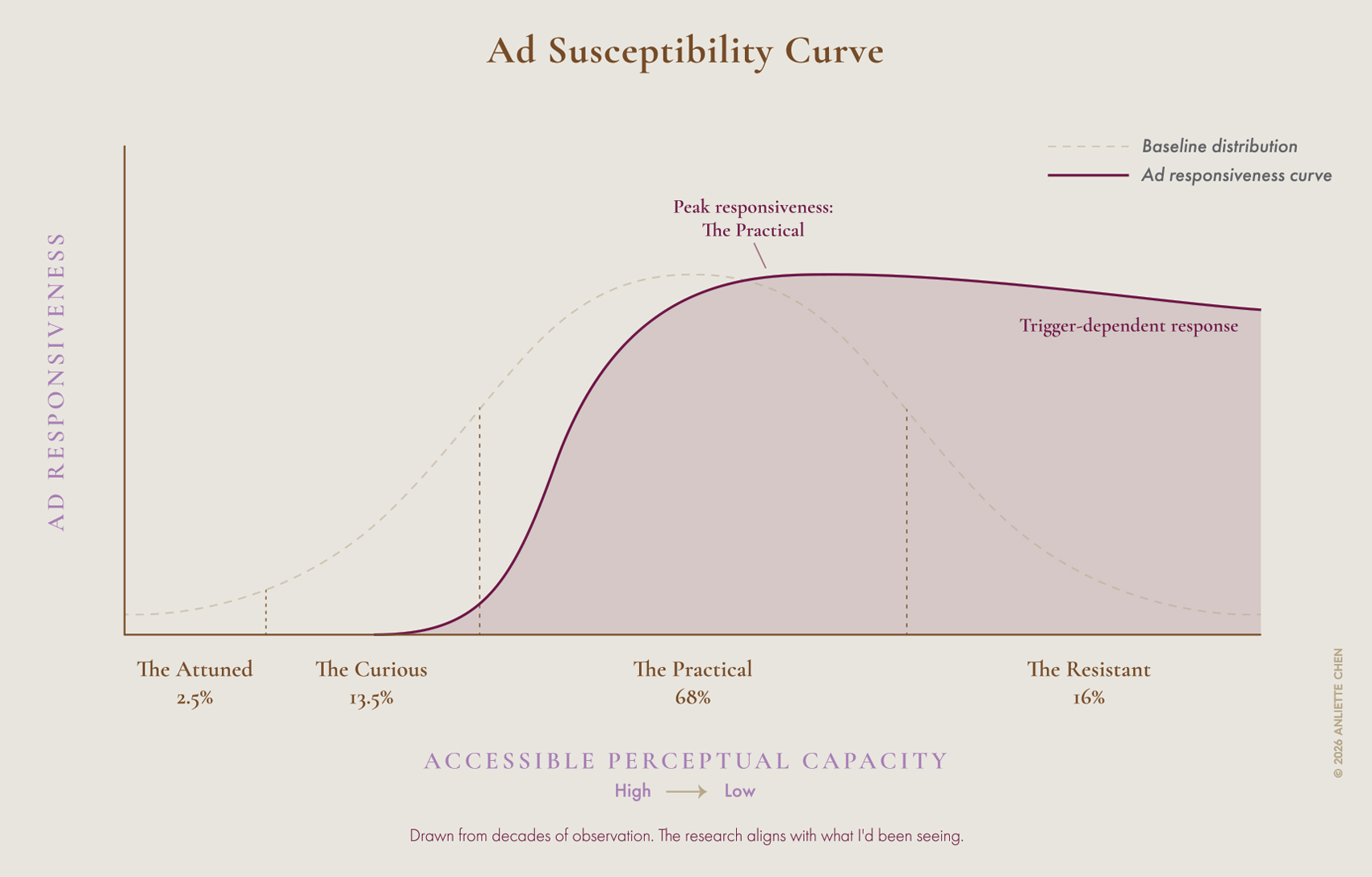
The Discerning 16% aren’t watching. The machine already knows this.
They stopped watching mainstream TV years ago. They know the Moroccan neighbour who brews rose tea from her garden. They go to the farmer’s market and touch, smell, ask the butcher, the cheesemonger, the épicière what’s in season this week. They find what they need through people whose perception they trust.
Their Sunday night is the front row of an intimate Malian kora and balafon concert, while the rest of the country is six ads deep into MAFS.
Their body already knows what to reach for.
There’s no gap left to fill.
So the machine doesn’t bother with them. It points its entire architecture at the right side of the curve, the Majority.
The people who are exhausted.
The 84% are not lazy. They’re depleted
You know the feeling.
It’s 9:47pm. You’ve done everything today that was asked of you, and several things that weren’t. You’re standing in the kitchen with a dishcloth in one hand and a phone in the other. Escaping the life you already have. Your partner asks what you want to do this weekend.
You hear the words. You understand every one of them. But the part of you that would’ve answered is already asleep.
You say, you pick.
When did you start letting others decide?
That kind of chronic stress impairs the prefrontal cortex, the part of the brain that lets you perceive nuance long enough to recognise it. The more weight it carries, the less you can see.2
Under pressure, the brain reaches for whatever is easiest.3
Repetition. Familiarity. Certainty. The exact register every ad on the tally speaks.
You cannot taste the difference in a bowl of food eaten at a desk between emails. You cannot feel the weight of a photograph someone waited years to make when your nervous system has had eleven notifications in two minutes. The signal exists. The body has no space to Re;ceive it.
The machine meets you exactly there.
Doritos doesn’t pretend to be food. Corn starch, flavour dust, a crunch engineered to override the body’s stopping mechanism. The orange powder is the fingerprint the machine leaves behind.
The 84% is a nervous system with one bar left.
What’s eroding here is older than judgement. Judgement can be retrained. What’s being chipped away is our Aesthetic Consciousness, our access to the inherent intelligence we were born with.
The machine didn’t sell to the depleted.
It created them.
The fingerprints
The machine is invisible until you see the carnage it produces.
Zara. SHEIN. Amazon.
Three brands. Same machine.
Zara speaks the visual language of premium. The store layout mimics luxury. The lighting is considered. The moment the Curious touches the sleeve, the lie is in the fabric. Polyester posing as silk, stitching that won’t survive three washes. A visual language designed to pass for the 16%, selling to the 84% whose nervous system has been too tired to feel the difference for years.
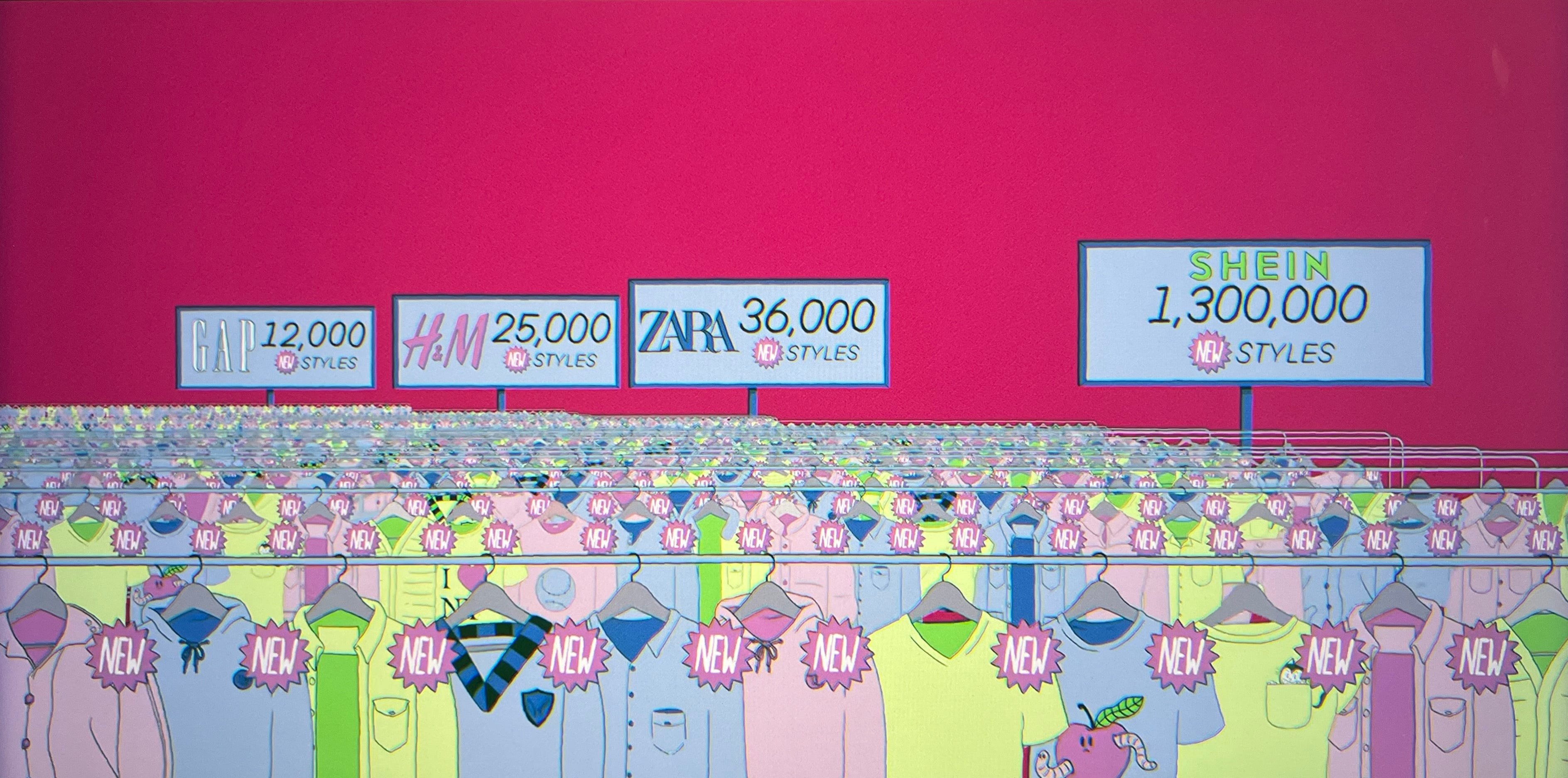
SHEIN doesn’t bother with any of that. 1.3 million new styles a year, generated and shipped before the last batch reaches landfill.
Zara is the lie in costume. SHEIN is the lie undressed.
Amazon is the overeager butler.
Coming right up.
Amazon started in 1994 selling books. Trustworthy, specific, easy to love. Now selling whatever you don’t need, engineered to arrive before you’ve had time to reconsider wanting it.
Charm first. Extract later.
Click at 2am. On your doorstep that afternoon. You were not supposed to win that round.
“Add $25 more for free shipping.”
You did.
The fashion industry produces between 100 and 150 billion new garments every year.4 5 million pairs of shoes by the time you finish one episode of MAFS.
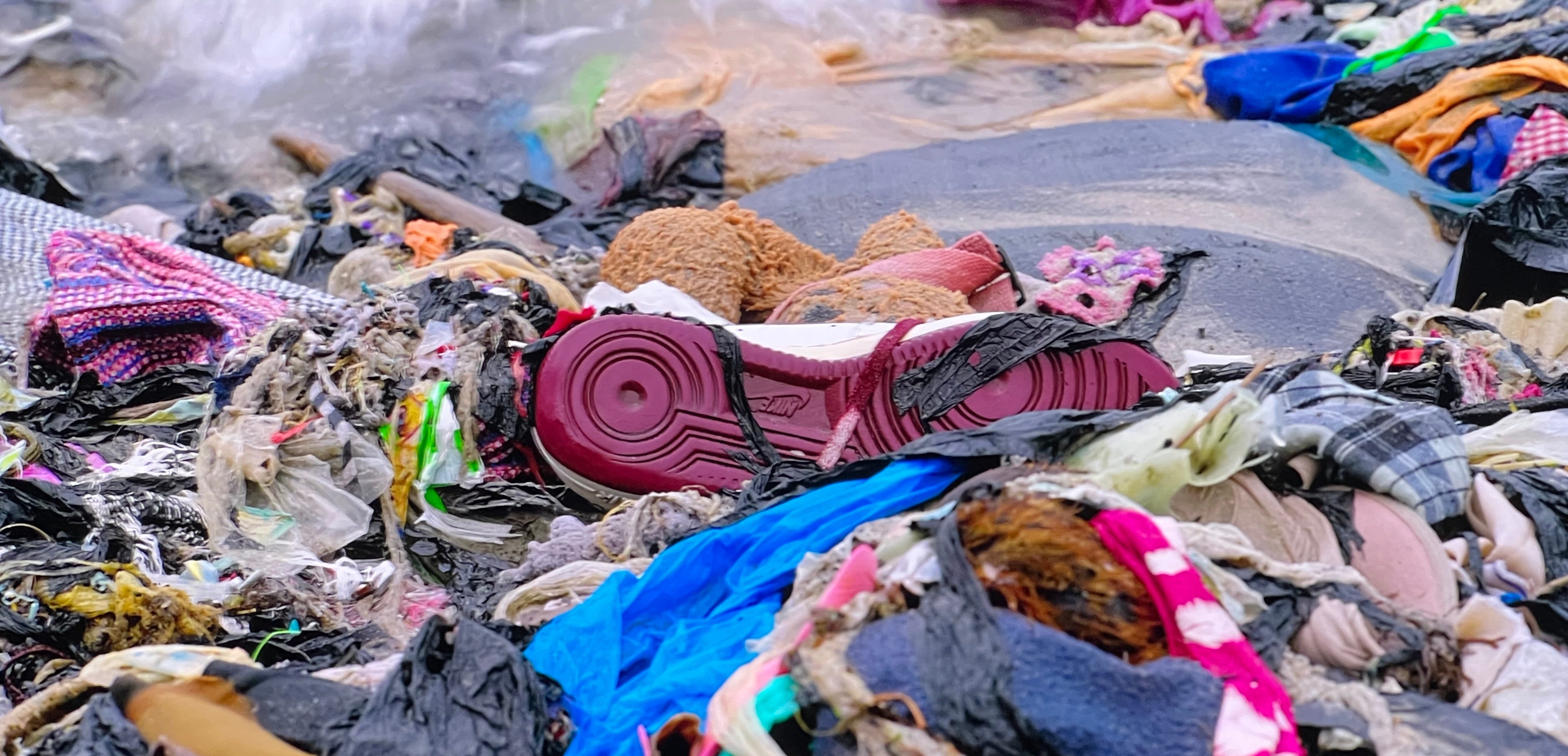
The planet kept the receipt.
In the Atacama Desert in Chile, discarded clothing piles up in mountains visible from space. Kilometres wide. Perfectly good garments, some still tagged, rotting in the sun next to shoes nobody wore. Whatever doesn’t stay in Chile washes up on the coastline of Ghana. 15 million items a week.
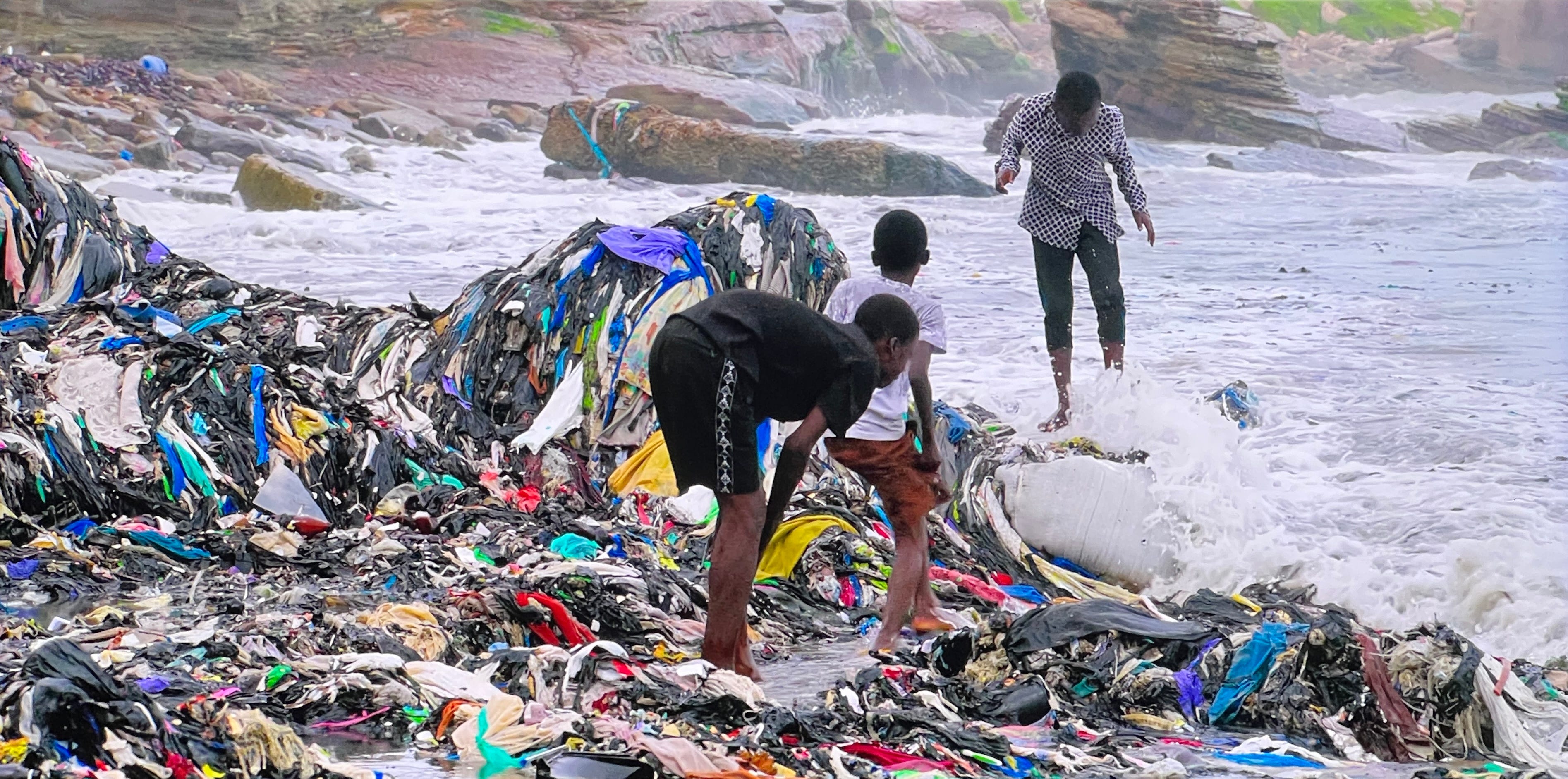
That is what the shiny buttons produce.
The other end you’re never supposed to see.
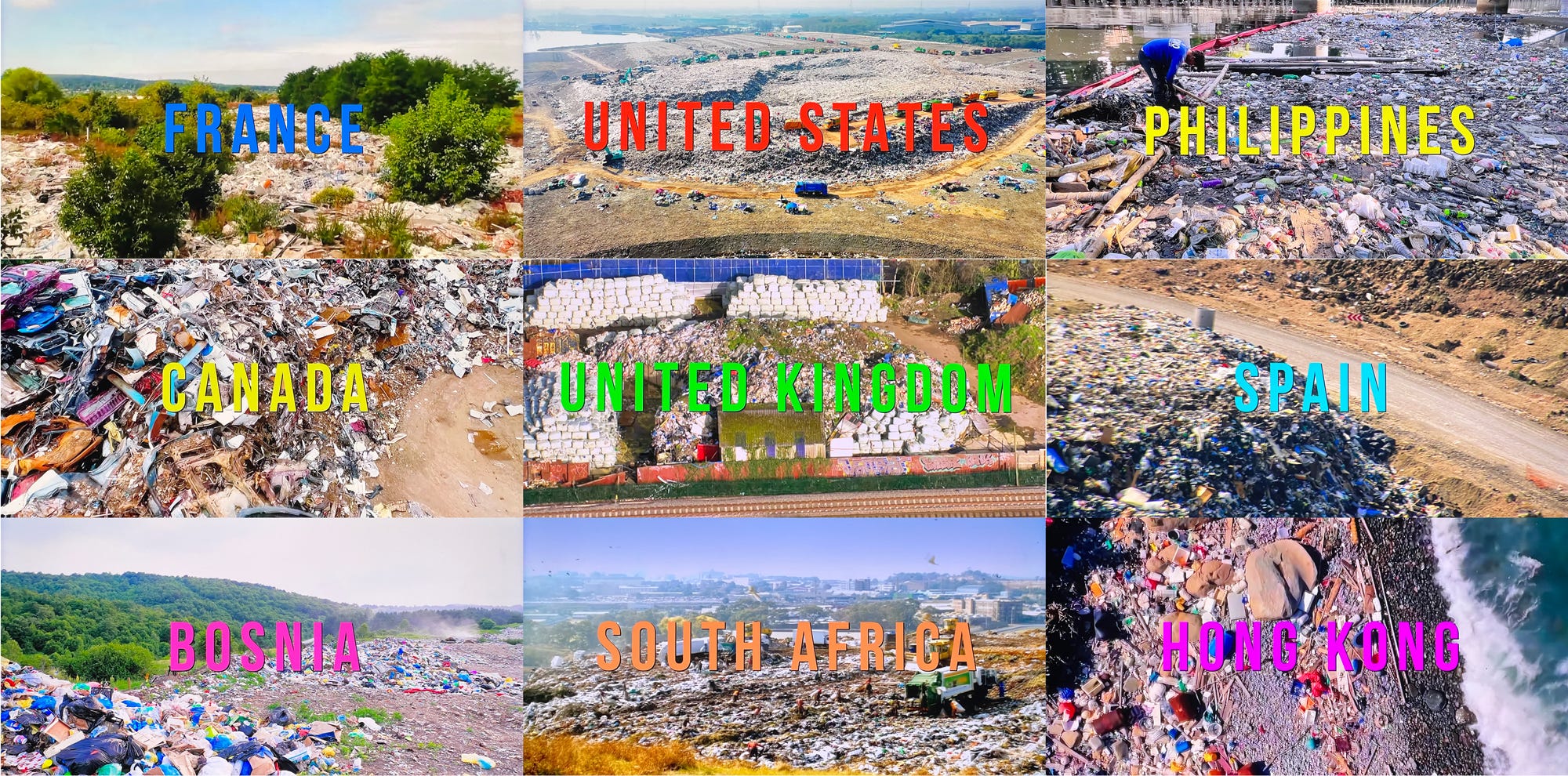
Every Black Friday, the conveyor belt gets dialled up another notch.
Somewhere, a body absorbs that speed.
This isn’t a metaphor.5
Manila, 2015
I took a photograph in Manila ten years ago.
I was on a charity mission, feeding hundreds of homeless children over two weeks. It was after I came out of my depression. I needed to be useful to someone.
I didn’t know then I was documenting evidence. My body knew before I did.

He was three, maybe four. Messy dark hair. A faded pink t-shirt with DUBAI printed across the chest. A plastic bowl of noodles in his lap. Small fingers going to his mouth.
His eyes held what every three-year-old’s eyes hold before the world teaches them otherwise. Curiosity. Hunger. Fatigue. A trust that had not yet learned to be suspicious. And something I could not label at the time, standing there with a camera and a depression I had only just crawled out of. The look a child gives you while his body is still deciding whether this is the world he was born into.
He had never been to Dubai.
The t-shirt arrived on a container ship from somewhere the machine had finished with it.
The noodles were not food. They were salt and starch engineered to keep small hands reaching back in.
Both of them were made for bodies somewhere else. Shipped here when no one else wants them, not even for free.
What I saw in Manila was communities that were food-insecure and simultaneously experiencing rising obesity, because the machine had found its most captive audience. The nervous system too occupied. The space for noticing worn thin. The alternatives rare.
And they were all oblivious to it.
Over a decade later, it still breaks my heart.
Not the hunger. The oblivion.
The targeting follows the depletion. It goes wherever the resistance is lowest.
I carried that photograph without knowing I was keeping it for this chapter.
In Chapter 6, I wrote about the children at the Joshua Bell experiment. The ones who tried to stop, every single time, before a parent reached down and pulled them away.
The hand that pulls them away was once pulled away too.
The machine doesn’t reach for the children. It reaches their parents.
That’s how it scales. Through inheritance.
The boy in the photograph was eating what his mother was given.
Somewhere up the line, someone reached for what came in a packet because it was cheaper than what their grandmother had cooked.
And the body forgot the difference.
We were all that child once.
Every single one of us. Before the machine.
The proof
Remember what I said I’d come back to?
While I was writing this chapter, I wanted to update a figure I’d used in an earlier essay on how much time people spend watching versus reading. My body told me to keep digging.
What I found confirmed what I had already seen.
The US government has been measuring something it doesn’t know.
84% of Americans spend five minutes or less a day reading for leisure.6
The remaining 16% read more than that.
That group has been shrinking.
The curve is still drifting to the right.
Five minutes.
You’ve already been here longer than that.
Reading is the minority behaviour now. The data is American. The pattern isn’t.
This is what that looks like.
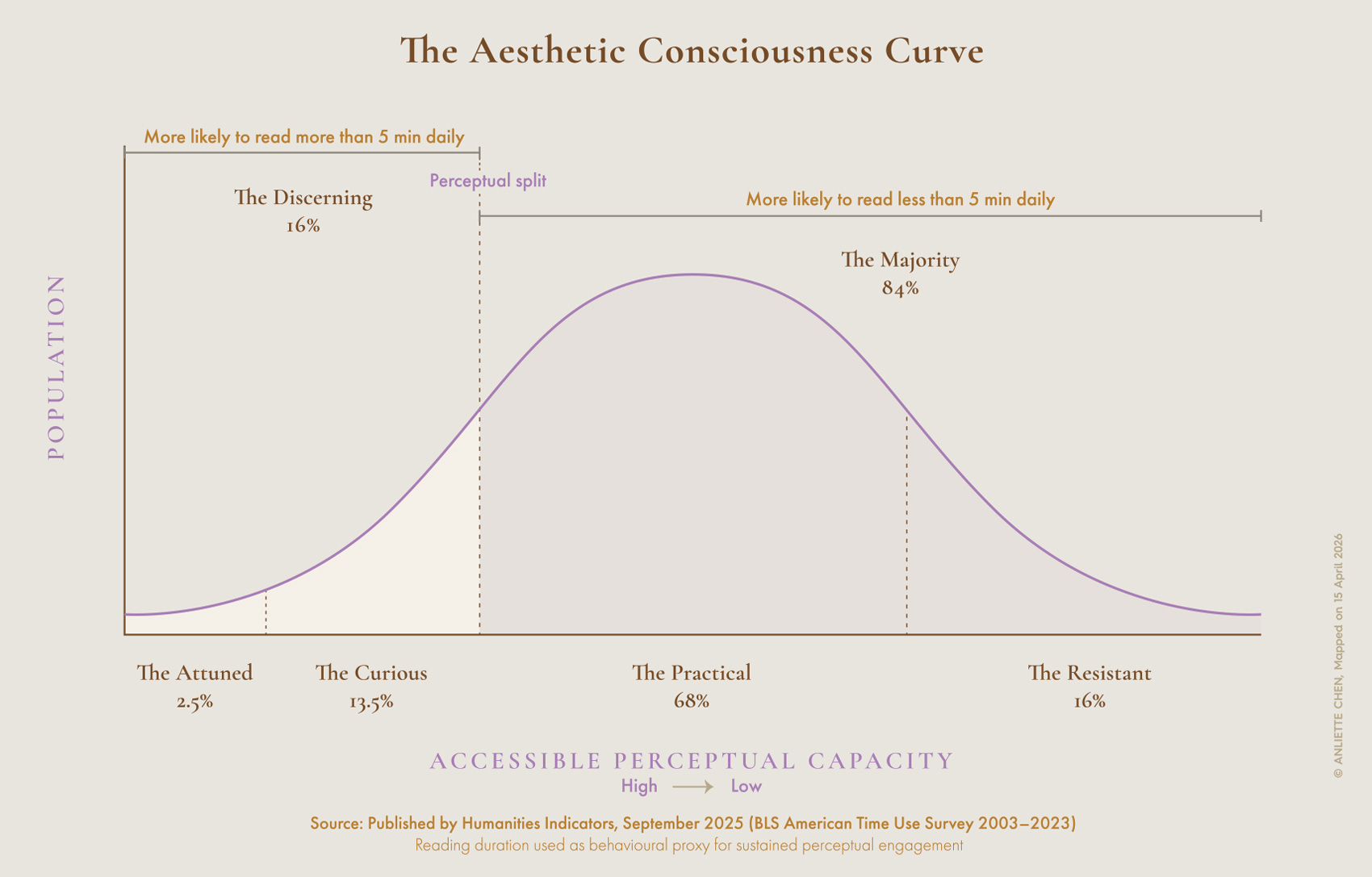
I named this split years ago. The data only confirms it now.
Reading time is one measure. Aesthetic Consciousness can be tracked in many ways. This is the first to land in data.
Before this, the pattern was visible only to me. The data made it visible to everyone. Which means we can do something about it.
The 16/84 split is real.
Aesthetic Consciousness is measurable.
And it’s moving.
The 84% isn’t a demographic.
It’s where people end up.
Two decades ago, 22% of Americans could sit with an argument long enough to follow where it goes. Today that number is under 15%. Seven percent of the population were pulled to the right side of the curve.
They got worn down.
We’ve passed the tipping point. The 16% is no longer 16.
The body that was never numb
The machine is not destroying our Human Aesthetic Intelligence. It cannot.
HAI is the ancient knowing you were born with. As distinct as your fingerprint, as old as the body you inherited from every mother who came before you.
The mother who knows her baby isn’t well before the baby can tell her.
That’s HAI.
A body you stopped listening to years ago. Still speaking. Unheard.
That’s what it costs when the channel erodes.
It cannot reach your HAI.
It can only make it harder for you to reach it yourself.
What gets eroded is the channel between you and what you were born already knowing. That channel deepens every time you practice Rare Attention™.
Not for self-improvement or for wellness.
For the fortitude to protect what is yours.
Your dignity.
The machine will keep running. It was built to run. And it’s very good at what it does.
It cannot end the signal. Only erode it.
It can scorch a jingle into your head while you cook. It can put a t-shirt on a boy in Manila who has never been to Dubai.
But it cannot remove the part of you that was already there when you were three. The part that knew to stop, every single time, before a hand reached down and pulled you away.
That part of you is still there.
The machine needs you numb.
You don’t have to be.
I’m building a diagnostic tool & companion to Rare Attention™ philosophy
Join the waitlist for early access:
Chapter 8 is about how the signal moves between us
© Anliette Chen 2026. All rights reserved.
The ideas, models, and original thinking in Rare Attention™ are the intellectual work of Anliette. If you reference, build on, or discuss these ideas elsewhere, please credit the source.
Further Reading
On advertising and what it actually does Tim Wu — The Attention Merchants (2016) B.J. Fogg — Persuasive Technology (2003) Chris Hayes — The Sirens’ Call (2025). Richard E. Petty & John T. Cacioppo — The Elaboration Likelihood Model of Persuasion (Advances in Experimental Social Psychology, 1986)
On platform lifecycles and extraction Cory Doctorow — Enshittification (2025)
On cognitive load and perception under stress Amy Arnsten — “Stress signalling pathways that impair prefrontal cortex structure and function” (Nature Reviews Neuroscience, 2009) Daniel Kahneman — Thinking, Fast and Slow (2011)
On fast fashion, extraction, and the landfill economy Elizabeth L. Cline — Overdressed (2012) Andrew Morgan — The True Cost (documentary, 2015) Nic Stacey — Buy Now! The Shopping Conspiracy (Netflix, 2024)
On reading and attention data American Academy of Arts and Sciences, Humanities Indicators — Time Spent Reading (September 2025)
The real tally is twice what’s published here. The original tally is on the comments section.
Amy Arnsten, Yale School of Medicine. Twenty years of research on chronic stress and the prefrontal cortex. See "Stress signalling pathways that impair prefrontal cortex structure and function" (Nature Reviews Neuroscience, 2009).
Under cognitive load, the brain shifts from slow, deliberate thinking (System 2) to fast, habit-based decisions (System 1). See Daniel Kahneman, Thinking, Fast and Slow (2011) — the foundational work on dual-process theory.
McKinsey and Ellen MacArthur Foundation; ~100 billion garments produced annually, first crossing that threshold in 2014. The World Economic Forum cites 150 billion as the current figure. Brands do not disclose verifiable production numbers.
U.S. Senate HELP Committee report, December 2024. Amazon warehouse injury rates more than double the industry average. Internal documents show nearly 45% of workers injured during peak periods like Prime Day and Black Friday.
Reading data: U.S. Bureau of Labor Statistics, American Time Use Survey (2003–2023). Analysis: American Academy of Arts and Sciences, Humanities Indicators, September 2025. Read full report. The 16/84 perceptual mapping is original to this chapter and the Rare Attention™ philosophy.
For those interested. This was the full list of the original ad tally from a 90 minutes MAFS segment:
Pepsi. KFC. Subway, eat. UberEats. Doordash, again. Activia, the good yoghurt. VB beer, wash it down. Cellarbrations, drink more. Youi insurance, in case it all goes wrong. Juniper diet program, fix it right after the KFC and Pepsi. Moisturisers. Iron supplements, repair the body you just ran through the loop. Pet parasite protection, keep something alive at least. Domain app, take on more debt. Nick Scali furniture clearance, fill the house. Big W, $29 vacuum cleaner, replace it when it breaks. Square POS system, keep the transactions moving. Vic government urgent care, you'll need it. Vanish washing powder. Clean it all. Unknown car brand, KIA, more SUVs. Move faster. Go further. Big 4 Holiday Parks, escape. A game show trailer, feel something upstairs. Ladbrokes bets, waste more money. Ryobi, make yourself useful. Chemist Warehouse vitamin C, sugarless, Pff...! Back to the body. Back to the loop. Harvey Norman sale. Again. KFC again. I had to cut them short for the published version of this essay.
Such an interesting take on how the machine preys on our susceptibilities with such erosive impact…